
|
The Rumford Store Log Lighter Valve 2/28/17
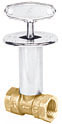
Key operated gas valve
|
|
Recommended Installation Instructions
|
|
|
In many areas only licensed plumbers are permitted to install gas lines and there are many safety issues to consider some of which are touched on below ...
Gas Line Size and Specification
|
|
Gas Line Size A one half inch gas line is typical and seems to be adequate for any of our Rumford gas log sets which put out from about 90,000 BTUs for the smaller sets to about 200,000 BTUs for the larger sets. Here is a discussion we found at http://ths.gardenweb.com/forums/load/plumbing/msg0817323129011.html that may help anyone who wants to determine the gas line size for themselves.
Size of gas line for 150,000 btu bbq The Code procedure for determining the size of gas lines is: 1. Determine the appliancd BTU demand per MFG specifications. 2. Determine the BTU/Cu.ft value of the gas from the local gas supplier. (typically 1,100btu/cu.ft) 3. Divide the appliance BTU by btu/cu.ft to determine appliance demand in cubic feet. 4. Measure the total developed length of pipe run. In this example the BTU demand is 150,000btu/hr Using the average btu/cu.ft of 1,100 btu we get 150,000 / 1,100 = 136 cu.ft/hr. From International Residential Code Table T2413.4(1) for metal schedule 40 pipe and a .5 psi(8oz) supply pressure we find that a 1/2" line can supply 175cu.ft/hr to a maximum length of 10'. At 20' it drops to 120cu.ft/hr which is below the demand. A 3/4" line could supply 138cu.ft/hr to a maximum of 60'. _________ 1/14/12 Code does not allow any cast iron fittings, only malleable fittings! First, cast iron pipe is only used for soil or waste lines, you cannot thread it. Cast iron fittings are not allowed because they can crack. Malleable iron fittings will stretch. Galvanized pipe is permitted outdoors above ground( minimum of 3 1/2" above grade). Once you go indoors, you are supposed to convert to black iron pipe (steel), copper or Corrugated Stainless steel tubing. You have to watch with copper because you cannot place flare fittings inside a wall or a place that you cannot readily access it. Galvanized pipe is steel pipe with a galvanized coating. The only way to properly use steel pipe underground it has to be wrapped in a coating acceptable for underground installations (also check with local codes). Once you go underground with a gas line, it has to be buried a minimum of 12" deep to top of pipe. You can use copper or they make a polyethylene tubing just for gas but you need to be licensed to purchase it, the same with the CSST(corrugated stainless steel tubing). Once again with the copper, you cannot bury any flare fittings underground. Copper can also be brazed but not soft soldered. I hope this clarifies some things for you. You can purchase from the NFPA the International Gas Codes book and the codes book on Propane . Look for the NFPA-54 and NFPA-58.
Vince, Imperial gas Piping LLC
_________
|
|
Sleeve Gas Line in masonry or concrete Gas lines into or through a masonry fireplace wall or hearth or throudh a concrete slab must be sleaved, preferably in Schedule 40 steel pipe, so that the pipe can be replaced. Pipe joints and fittings may not be inaccessible within the concrete or masonry. See Section G2415 (404) of the IRC.
|
|
Combination or Alternative Wood/Gas Set Up Some of our customers have asked about burning wood or gas in their Rumford depending on how they feel or the time of day. They may really prefer a wood fire but sometimes, they say, they come home late and only want a fire for about half an hour and don't feel like building a wood fire. |
|
It takes about an hour to install or un-install a gas log set and wouldn't be something you'd want to do twice a week. How about just putting the ceramic logs in the fireplace and turning on the log lighter? It probably wouldn't look very satisfying is the answer. The gas log sets have a carefully arranged four level burner system and fake ashes to make the fire look very realistic. So here's an idea one of our customers had: He had run the gas line as we recommend above, stubbed out in the center of the firebox about 2" forward of the fireback capped by a pipe cap with two 1/8" holes drilled in it for gas starter. Now he added an 8" section of 1/2" gas pipe with several more holes drilled in the pipe under the cap to augment and raise the height of the flame - perfect for an impressive fire inside the ceramic logs placed on end around the gas pipe burner. And he can stack real wood around the 8" pipe burner just as easily the next night.
|
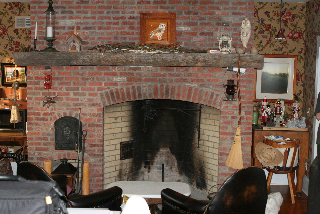
Click for more pictures and customer's comments.
|

|
Are Log Lighters Required to be listed or Approved? CSA Requirement No. 8 covering log lighters was withdrawn on January 1, 2009. The definition was then revised in the International Fuel Gas Code (IFGC) since a log lighter is more typically viewed as a fireplace accessory then an appliance. The revisions to section 608.1 of the IFGC allows for the installation of an unlisted log lighter fireplace accessory when approved by the code official. While section 105.2 can be used to approve these accessories, specific coverage in 608.1 was approved since unlisted log lighters are the only types available. The accessory's inherent simplicity is the reason for the lack of listing and the withdrawal of the CSA requirement. A typical log lighter is an iron pipe with drilled holes and shut off valve. They can be constructed on site from readily available materials or are available from small fabricators as complete units or kits. There is a lack of a mass market demand and thus the market is supplied by small fabricators.
See IFGC 2009 changes
|
|
What About Propane? Mar 17, 2011 Jim, The web page above has the following instructions for a gas starter. Will this also work for propane? Thanks, Tim Smith Seven Star 512 748 1556 www.sevenstarconsolidated.com
Tim, That's a good question and I will find out. But that means buying and pouring over the National Fuel Gas Code which will take me a while. In the mean time probably any plumber who runs gas lines or any plumbing inspector might know the answer. Propane, as you know, is heavier than air and so must be treated carefully. If you had a leak or inadvertently left the valve partially opened without lighting it the gas would puddle and flow down hill maybe into a basement where it might find a pilot light and blow up. I have seen houses with gas drains and I would be less worried if your house was built on a slab with no basement but, until I read the code, I don't know what is required. If you find out please let me know. And I will try to remember - by putting your question among the comments here - to get back to you when I do found out.
Best,
South Carolina does not allow log lighters on any propane system. The system has to have a safety pilot valve for protection. I cannot say about other states but I would err on the side of caution and not install on a propane system.
Vince, Imperial Gas Piping LLC
|
|
Air mixing gas log lighter Feb. 27, 2017 Hi Jim, I once had a two piece log lighter about 4” round cup 4” tall with threaded pipe inlet near bottom and the removable Venturi set into the cup and flush with fire place floor. This I installed in my Rumford FP 15 years ago. I purchased it from a fireplace and foundry outlet in New York I, problem is I cannot seem to find my paperwork for this supplier. I thought I saw something similar in your store under gas logs but no luck with log lighters. I am wondering if you might be able to help me with the name of such a manufacturer? This product is of cast iron and of quite simple and of old design and may not have AGA marking.
Best regards,
Sounds interesting. I’ve not seen it but I’ll try to find it. Probably the company is out of business like most of the foundries. We just go simple - gas pipe stubbed up 2”, capped and with two 1/8” holes drilled in the cap. See http://www.rumford.com/store/gasvalve.html My experience with gas logs is that you don’t need a Venturi air mixer with natural gas. You might not get an efficient blue flame but generally gas logs are set up to burn rich with a yellow flame that looks more like the flame in a wood fire. Same with a gas starter - you just want the gas to burn and it gets pretty much air anyway. Maybe not true with heavier Propane gas which burns smokey without sufficient air.
Best,
|

Back to Gas Logs
Buckley Rumford Fireplaces
Copyright 1995 - 2017 Jim Buckley
All rights reserved.
webmaster